Unraveling Root Equations: A Comprehensive Guide to Solve
The root of a number, in mathematics, is the value that, when multiplied by itself, gives the original number. For example, the roots of 4 are 2 and -2 because 2 x 2 = 4 and -2 x -2 = 4. Understanding how to find roots is crucial in various fields of mathematics, and here, we'll explore two common methods to solve for roots: factoring and using the quadratic formula.
Before diving into these methods, let's ensure we're clear on the terminology. The root we're looking to find is called a 'solution' or 'answer', and the equation we're solving is often referred to as the 'original equation'.
Factoring to Find Roots
Factoring involves breaking down a mathematical expression into its simplest parts. In the context of finding roots, we aim to factor the original equation into a product of binomials. The roots of the equation are then easily determined as the numbers that remind us of the factors.

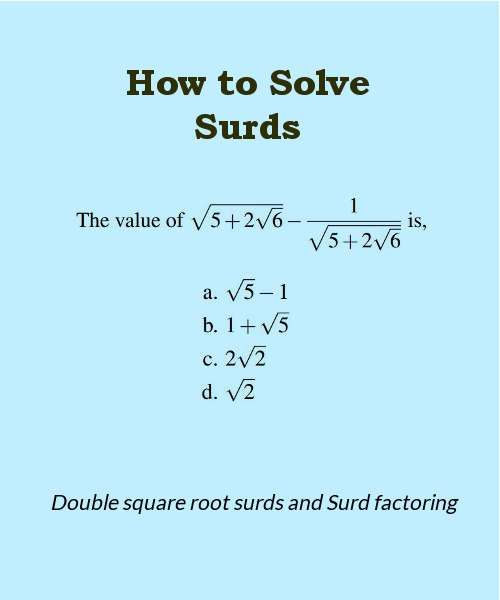

Let's consider the equation x² - 5x + 6 = 0 as an example. We can factor this quadratic equation as (x - 2)(x - 3) = 0. By setting each factor equal to zero, we find the roots: x = 2 and x = 3.
Steps to Factor a Quadratic Equation
- Find the first two terms of the equation (in this case, x² and -5x).
- Determine the constant term (the last term, which is 6).
- Find two numbers that multiply to the constant term and add to the coefficient of the first term (the middle term). In our example, these numbers are 2 and 3 because 2 x 3 = 6 and 2 + 3 = -5.
- Rewrite the equation using these numbers: x² - 5x + 6 = (x - 2)(x - 3).
- Set each factor equal to zero and solve for x to find the roots.
When Factoring Isn't Easy
Some equations can't be factored easily or at all. In such cases, we can use the quadratic formula to find the roots. The quadratic formula uses the coefficients of the equation to produce the roots without the need for factoring.


The Quadratic Formula
The quadratic formula is a simple and direct method for finding the roots of a quadratic equation. The formula is: x = [-b ± sqrt(b² - 4ac)] / 2a, where a, b, and c are the coefficients from the quadratic equation ax² + bx + c = 0. The expression under the square root sign, b² - 4ac, is called the discriminant.
Let's apply this formula to the equation x² - 5x + 6 = 0. Here, a = 1, b = -5, and c = 6. Plugging these values into the quadratic formula, we get:
x = [-(-5) ± sqrt((-5)² - 4(1)(6))] / (2(1))
Simplifying this expression, we find the roots to be x = 2 and x = 3, which is the same as we found when factoring.
The Role of the Discriminant
The discriminant (b² - 4ac) plays a crucial role in determining the nature of the roots of a quadratic equation. The three possible outcomes and their corresponding root types are summarized in the table below:
| Discriminant (b² - 4ac) | Nature of the Roots |
|---|---|
| Positive | Real and Distinct |
| Zero | Real and Equal |
| Negative | Imaginary |
Calculating Imaginary Roots
When the discriminant is negative, the roots are imaginary. To find these roots, we use the quadratic formula and include the imaginary unit 'i' (where i² = -1) in the expression under the square root. The formula then provides the roots as pr + i gs, where p, q, and s are real numbers.
In the world of mathematics, there are many ways to find the roots of an equation. However, factoring and using the quadratic formula are two of the most common and efficient methods. By mastering these techniques, you'll be well-equipped to solve for roots in a wide range of mathematical scenarios. So, whether you're working on algebra problems, planning a garden, or designing bridges, understanding roots can unlock new insights and solutions. Now, armed with this knowledge, go forth and multiply – not just numbers, but also your understanding of the fascinating world of mathematics!
Related Articles

Mastering Double Absolute Value Equations: A Comprehensive Guide
Solving double absolute value equations might seem daunting at first, but with the right approach and a bit of practice, you'll find them quite manageable...

Mastering Pyramorphix: A Comprehensive Guide to Solving
Ah, the Pyramorphix - a puzzle that seems to evoke a blend of intrigue and frustration in equal measure. But fear not, with a few clever steps and some...

"Unraveling Your Family History in Fallout 3: A Comprehensive Guide
Embarking on a journey through the post-apocalyptic wasteland of Fallout 3, many players find themselves seeking answers about their past, including the...

Mastering Hanayama Puzzles: A Comprehensive Step-by-Step Guide
The humble yet intricate Hanayama Puzzles, crafted with the motto "Slide and turn, simple yet difficult", have captivated puzzle enthusiasts worldwide. These...

Unraveling the Clues: Your Comprehensive Guide to Writing Middle Grade Mystery
Unraveling the Mysteries: A Comprehensive Guide to Writing Middle Grade Mysteries - Your Blueprint to Success In the captivating realm of middle grade...

Mastering Radicals: Step-by-Step Guide to Solving Equations
Radical equations, involving variables in the denominator raised to powers, can seem intimidating at first glance. However, with a systematic approach, you can...